



Certosa di San Martino – Where Naples Keeps Its Memories
A Carthusian monastery next to Castel Sant'Elmo, where Baroque marble, silent cloisters, royal carriages and the city's most famous nativity scene share one ticket and one of the widest views over the Gulf of Naples.
Most people come up the Vomero hill for Castel Sant'Elmo and the view. Then they notice the long white complex just below the castle walls and wonder what it is. That's the Certosa di San Martino, and if you only have time for one of the two, we'd quietly point you here.
Founded in 1325 by Charles, Duke of Calabria, son of King Robert of Anjou, and consecrated in 1368, this was home to the Carthusians, an order that took silence, solitude and prayer very seriously. It took decoration seriously too. Between the late 16th and the 18th century the monks rebuilt and redecorated almost everything, hiring the leading architects, painters and sculptors in Naples, until the medieval monastery all but disappeared under one of the great Baroque ensembles in Italy.
In 1866, when religious orders were suppressed and the Certosa passed to the State, the archaeologist Giuseppe Fiorelli turned it into a museum. Yes, the same Fiorelli behind the plaster casts of the victims of Pompeii. Purchases and donations did the rest, and today the Museo Nazionale di San Martino tells the story of Naples through its art, its ceremonies and its obsessions. One ticket covers the lot: church, cloisters, gardens and collections.
The church and the treasury
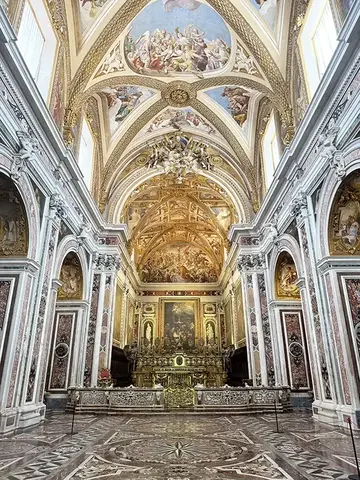
You come in through the Chiostro dei Procuratori, the smaller cloister where the monks who ran the community's business affairs lived, and from here you step into the church. Prepare to stand still for a while. The Gothic structure is still there, but what you see is Cosimo Fanzago's polychrome marble inlay, Giovanni Lanfranco's frescoed vault and Jusepe de Ribera's prophets looking down from the arches of the nave. The monks paid Fanzago 57,000 ducats over 33 years of work. Silence was free; marble wasn't.
Don't skip the rooms beyond the altar. The sacristy holds Massimo Stanzione's Ecce Homo, and the Cappella del Tesoro Nuovo has Ribera's Pietà of 1637 alongside Luca Giordano's Triumph of Judith, painted in 1704.
Carriages, coats of arms and a column of shame
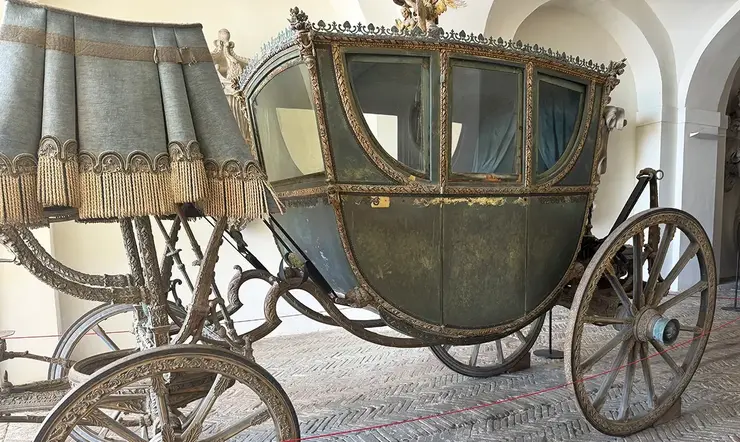
Covered and paved in 1886, the Androne delle Carrozze links the Chiostro dei Procuratori to the gardens. Two carriages stand here. The older one is the gilded state coach of the Eletti, the noblemen who governed the city, built between the late 1600s and early 1700s and used for Corpus Domini processions and the Piedigrotta festival until 1861. The other is a court berlin of 1804 associated with Maria Cristina of Savoy, wife of Ferdinand II, which took her to gala occasions at the Duomo.
Look at the walls too. The large stone coats of arms were rescued from city gates, castles and buildings demolished during the Risanamento. The biggest comes from the old Porta Medina, designed by Fanzago and pulled down in 1873; the arms of Philip IV of Spain that once decorated it were chiselled away in 1799 by the revolutionaries of the Neapolitan Republic. Opposite hang the Bourbon arms removed from Castel Nuovo after Unification, and an old milestone still measures the road from Ponte della Maddalena all the way to Reggio Calabria.
And then there's the plain white column on the left: the Colonna della Vicaria, which once stood in front of Castel Capuano, the city's law courts. See the box below for what happened there.
The prior's quarters and the view
The Quarto del Priore was the apartment of the community's spiritual leader, with reception rooms for distinguished guests and walls hung with the monastery's paintings. The French confiscated the collection in 1806 and it was scattered, but a few survivors remain: panels by Jean Bourdichon, and the wings of a 15th-century Hispano-Flemish triptych in which King Robert of Anjou and his son Charles, the Certosa's founder, appear as two of the Magi. Not a bad way to sign your work.
Then walk out into the gardens. The terraces and the belvedere open onto the whole city: the centro storico below, Spaccanapoli slicing through it in a straight line, Vesuvius beyond and the gulf to the right. On a clear day you'll understand why the Carthusians chose this hill. Bring your camera, and some patience for everyone else who had the same idea.
The great cloister and the monks' cemetery
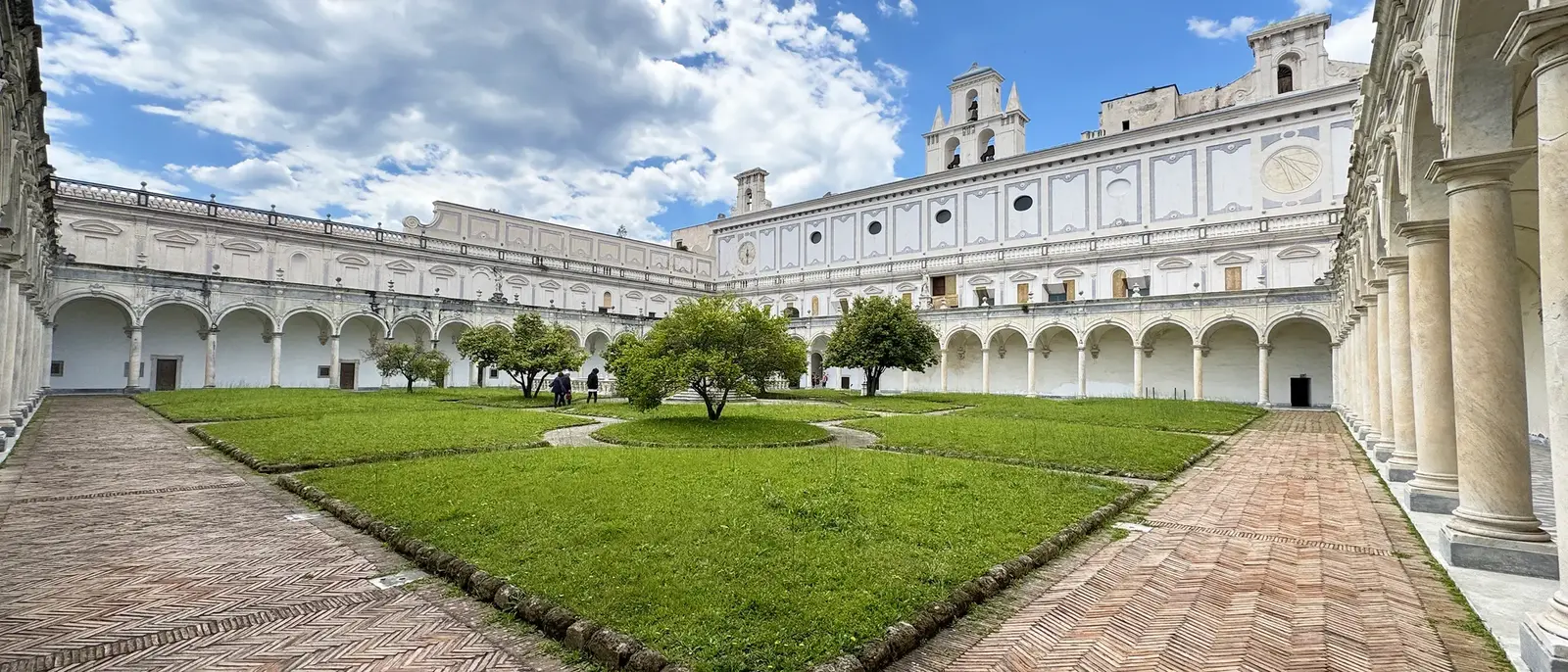
The Chiostro Grande, also called Galilea maior, was the heart of Carthusian life. The monks lived in individual cells along three of its sides, and you can still see their doors and the small hatches, the passavivande, through which meals were passed so that nobody had to talk to anybody. The Renaissance arcade was begun by Giovanni Antonio Dosio in the late 16th century, continued by Giovan Giacomo Conforto and finished by Fanzago, who added the theatrical corner portals crowned by busts of Carthusian saints.
Fanzago also designed the small monks' cemetery in one corner, fenced by a marble balustrade lined with skulls. In the sunshine they look almost cheerful. The brothers were buried here without coffins, straight into the earth, under an anonymous cross: austere in life and austere after it. It's a quiet, strange corner, and very Neapolitan in its frank familiarity with death.
Nativity scenes, royal boats and a city in pictures
The museum sections run along the cloister, and this is where an afternoon can easily disappear. The Sezione Presepiale, set in the monastery's old kitchens, holds the main public collection of Neapolitan nativity figures in Italy.
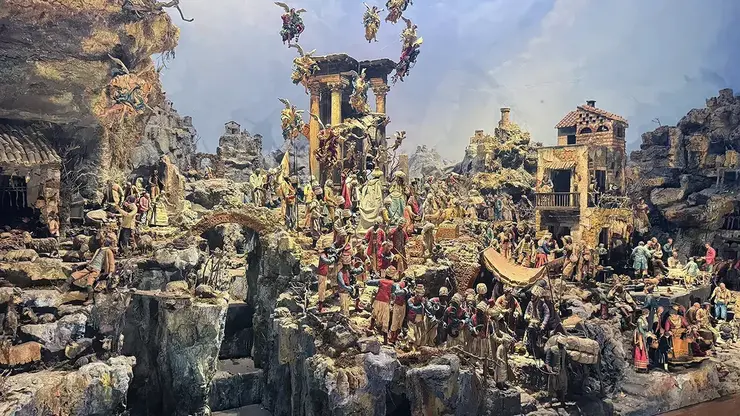
Its centrepiece is the Presepe Cuciniello, donated in 1879 by the architect and stage designer Michele Cuciniello, who arranged it himself. You can tell. Around 800 figures, animals and miniatures from 18th and 19th century workshops fill the three canonical scenes: the Annunciation to the Shepherds, the Nativity and the Tavern. Nobles and beggars, vendors and artisans, palaces and ruins: it's Naples in miniature, and the crowd in the tavern seems to be having a much better time than the shepherds. Nearby stand the surviving figures of a life-size nativity carved for the church of San Giovanni a Carbonara by Pietro and Giovanni Alamanno, northern sculptors working in Aragonese Naples.
The Naval Section has scale models of the shipyards of Naples and Castellammare and a few real royal boats: a 24-oar barge built at the Naples Arsenal under Charles of Bourbon, a 14-oar one made in 1889 for Umberto I of Savoy, and a Turkish caique sent by Sultan Selim III to Ferdinand IV. Diplomatic gifts were more fun back then.
Immagini e Memorie della Città follows how Naples changed from the Renaissance onwards, starting with the Tavola Strozzi, the 15th-century panel showing the city from the sea. You may have seen it on a postcard or a book cover, but standing in front of the real thing is a bit like meeting Botticelli's Primavera at the Uffizi.
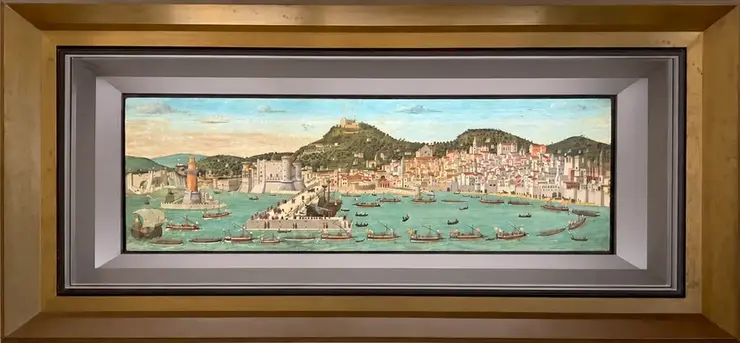
The Ottocento a Napoli section, in the old guest quarters, runs from the Posillipo School of Giacinto Gigante and Anton Sminck Pitloo to Domenico Morelli and Antonio Mancini. The Theatre Section keeps paintings, prints and memorabilia of Neapolitan theatre, including a model of the stage of the old Teatro San Carlino, Pulcinella's home ground.
How to visit
The Certosa is at Largo San Martino 5, at the top of the Vomero, right next to Castel Sant'Elmo. The easy way up is a funicular to the Vomero, then a ten-minute walk. Fit legs can climb the Pedamentina steps from Corso Vittorio Emanuele instead, with the view as a reward on the way.
Since July 2026 the museum is open every day except Tuesday, 8:30 to 18:30, last entry 17:30. Tickets are €6, €2 for visitors aged 18 to 25 and free under 18. Allow at least two and a half hours, three if you're into nativity scenes. Not every section is always open, and that includes the Sotterranei gotici, the massive 14th-century vaults that hold the whole monastery up, now lined with around 150 marble inscriptions and sculptures. If there's something you particularly want to see, ask at the ticket desk.
Curated by
Katia Fiorentino
Art Historian & Former Senior Official

Katia Fiorentino is an art historian who built her career as a senior official at the Soprintendenza per i Beni Artistici e Storici di Napoli, based at Castel Sant’Elmo. Over the years she developed deep expertise in the city’s cultural institutions and its artistic heritage. Now retired, she brings to Ciao Napoli an insider’s knowledge of Naples that few can match.
Related places
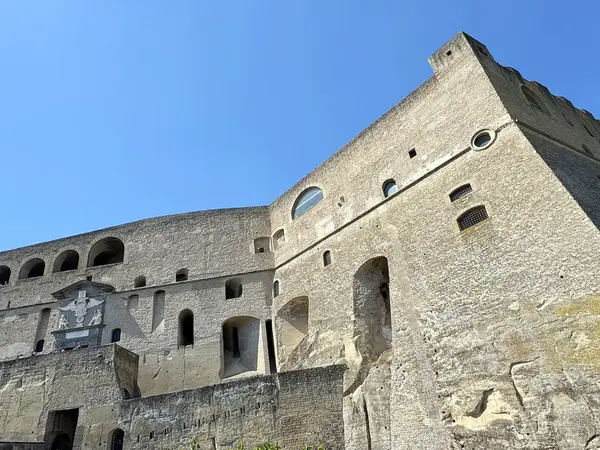
Castel Sant'Elmo
The star-shaped fortress crowning the Vomero hill. Come for the 360° view over the gulf and the historic centre, stay for the ramparts, the history and the Novecento art museum.
 inside
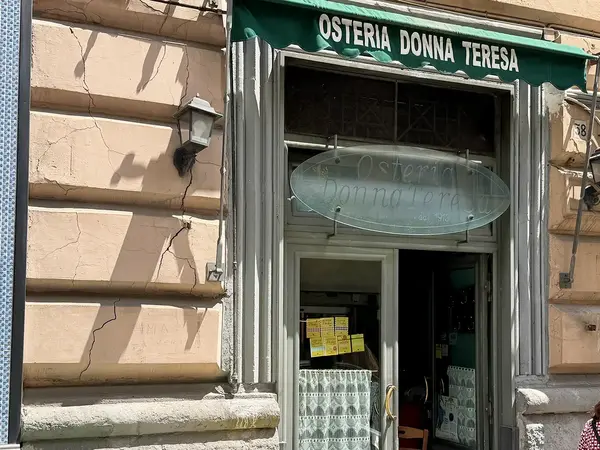
Osteria Donna Teresa
A century-old trattoria in Vomero where the menu is told at the table and lunch tastes like Sunday at a Neapolitan grandma’s.
inside
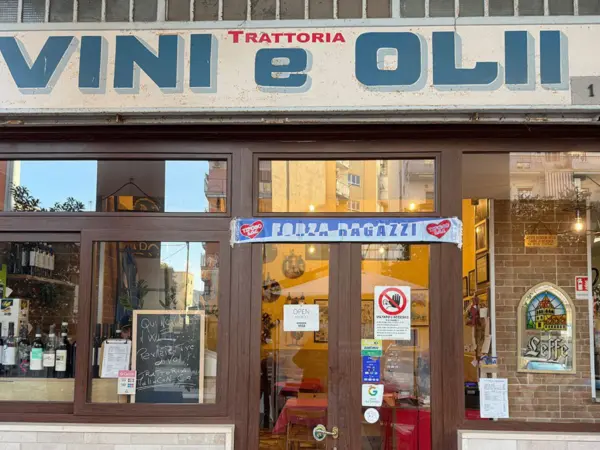

Trattoria Malinconico
This one is really for local lovers. People from Vomero (and not only) come here for their lunch break. Prices are very reasonable and the food is very genuine.
inside