



Chiaia, where Naples dresses up
The Chiaia neighbourhood runs along the seafront from Piazza Vittoria to Mergellina — grand Liberty palaces, designer boutiques, a promenade facing Vesuvius, and streets that come alive well into the night.
(Read more)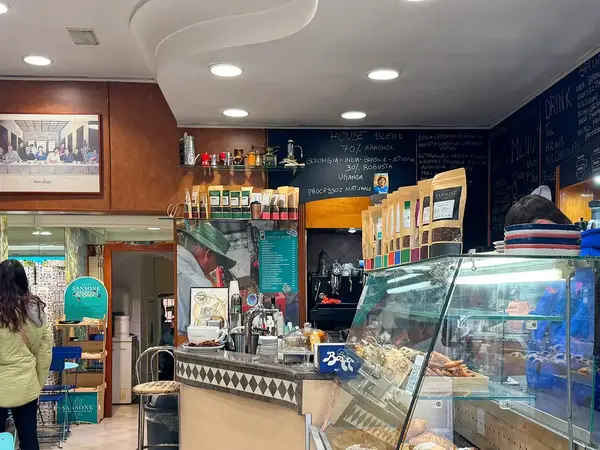
Caffè Sansone
A Naples micro-roastery where the classic espresso gets a quiet reinvention. Artisan blends, rotating single origins, and real passion for the craft.
 inside
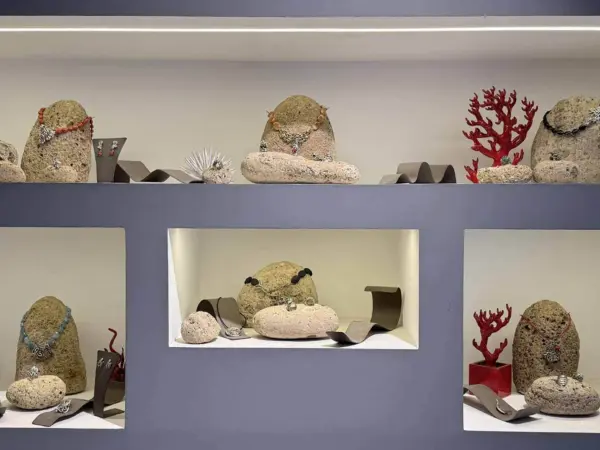
Pietrasalata (Valerio Pirolo)
Handcrafted silver jewellery by Neapolitan artisan Valerio Pirolo. Each piece is shaped in wax, oxidised with sulphur and drawn from the natural world of the Mediterranean.
A neighbourhood born outside the walls
Chiaia's name comes from the Latin plaga, meaning shore or beach. The reason is that this was once the city's coastline, a borough that grew up outside Naples' historical boundaries in the 16th century. The Spanish rulers who ran Naples at the time pushed the city westward, and Chiaia slowly filled in with palaces, gardens, and churches. By the 18th century it had become the address of choice for the Neapolitan aristocracy and the grand European visitors who came in their wake — and it has never really looked back.
Via Chiaia and the streets around it
The neighbourhood's spine is Via Chiaia itself, which follows an ancient route that once connected Naples to Pozzuoli. By the 1700s it had become the city's most competitive shopping street, lined with Baroque façades, decorative portals, and occasional courtyards seen through open gateways. The Ponte di Chiaia, a bridge built in 1636 to connect the hills of Pizzofalcone and Mortelle, is one of those lovely Naples details that rewards the curious. From here, Via Filangieri and Via dei Mille continue the route: Liberty-style palaces from the early 1900s, including the Palazzo delle Arti di Napoli (PAN), and the Palazzo Mannajuolo with its famous elliptical staircase.
Piazza dei Martiri
At the centre of Chiaia lies Piazza dei Martiri, one of Naples' most beautiful squares and a good place to orient yourself. The column at its centre, raised in 1866–68, carries four lions at its base — each in a different pose, each representing one of the anti-Bourbon uprisings of the 19th century (1799, 1820, 1848, 1860). The palazzo on the square with the most interesting backstory is Palazzo Sessa, once the residence of Sir William Hamilton, British ambassador, obsessive antiquities collector, and husband of Emma Lyon, who became Lady Hamilton and famously captured the attention of Admiral Nelson. The building now houses Naples' small Jewish synagogue.
Where the big names come to Naples
The axis of Via Chiaia, Via Filangieri and Via dei Mille is where the international fashion houses have planted their flags: Gucci, Louis Vuitton, Ferragamo, Hermès, Bulgari, Prada. This is not where Neapolitans do their everyday shopping — it is where you come when you are buying something specific and serious. What gives it more texture than a generic luxury corridor, though, is the presence of the city's historic tailoring ateliers alongside the global brands. Neapolitan bespoke tailoring is among the most respected in the world, and several of the workshops that carry that tradition are based here.
The lungomare and Villa Comunale
Down at sea level, the Riviera di Chiaia and Via Caracciolo form one of the great urban promenades in Italy. It’s wide, breezy, and facing Vesuvius across the water. Running between the promenade and the neighbourhood proper is the Villa Comunale, the city's grand public park. Originally built in 1780 at the order of King Ferdinand IV as a garden for the nobility, it only opened to everyone after the Unification of Italy in 1869. Inside the park, the Stazione Zoologica Anton Dohrn, founded in 1872 with the backing of Charles Darwin among others, is today one of the world's leading marine biology research institutions. The aquarium inside is one of the oldest in Europe. Most visitors walk past without knowing what it is.
The movida and everything else
Come evening, a different Chiaia comes alive. The maze of alleys between Via dei Mille and the seafront — Vico Belledonne, Vico Satriano, and the streets around them — fills up with Neapolitans of all ages doing what Neapolitans do best: standing outside, talking loudly, and taking the night very seriously. The aperitivo bars here are very good, the seafood restaurants are among the freshest in the city, and the whole thing goes on considerably later than you probably planned for. Worth knowing: the crowd tends to be young and it can get busy. If you are after a quiet dinner, book somewhere with a table inside and a door that closes.
A word on the Villa Comunale right now
Neapolitans have always thought of the Villa Comunale as their living room facing the sea, which makes it all the more painful that for years it has been more building site than garden. A long-overdue restoration is finally underway, funded with around nine million Euros, but the work is moving at a measured pace, shaped by the usual variables: technical issues, weather, and the step-by-step restoration of statues and fountains. Partial sections are expected to reopen through 2026, with the more ambitious work on monuments and the historic Cassa Armonica stretching into the following year. Go anyway, the promenade and the sea views are always there, but lower your expectations for the park itself, at least for now.