



San Ferdinando, the heart of the matter
If Naples has a stage, it is San Ferdinando. This is the neighbourhood of via Toledo and the Galleria Umberto I, of the Royal Palace and Castel Nuovo, of the oldest café-chantant in Italy and a castle built on a magic egg. It’s the city’s ceremonial heart, and its streets have been carrying the full weight of Neapolitan history — Greek, Roman, Spanish, Bourbon — for more than two thousand years. Compact, walkable, and full of places to see.
(Read more)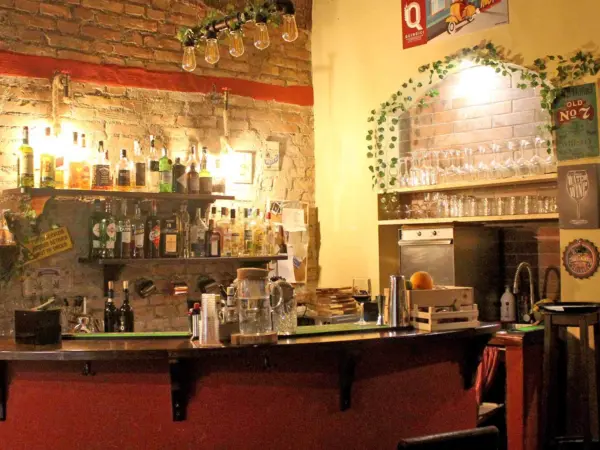
Decanter Wine and More
A cosy wine bar steps from Via Toledo where sommeliers Fabrizio and Carol walk you through Campania's best bottles paired with taglieri deserve a second round.
From Partenope to the Spanish viceroys
The ground beneath San Ferdinando is where Naples begins: on the islet of Megaride (where Castel dell’Ovo now stands) settlers from Cumae founded a Greek outpost in the 6th century BC, a nucleus that would eventually grow into Neapolis. The Romans built over it, the Normans fortified it, and the Spanish viceroys later reshaped the district; above all don Pedro Álvarez de Toledo, governing for Charles V in the early 16th century, who drove via Toledo through the neighbourhood and built the Quartieri Spagnoli alongside it, giving San Ferdinando the urban bones it still has today.
Castel Nuovo and its crocodile
Castel Nuovo, known to everyone as the Maschio Angioino, was begun by Charles I of Anjou in 1279 and rebuilt by Alfonso of Aragon in the 15th century, when the magnificent triumphal arch at its entrance was added to celebrate Alfonso's entry into Naples in 1443. Boccaccio, Petrarca and Giotto all passed through during the reign of Robert of Anjou. Underneath the noble halls, a network of dungeons extends toward the sea, and with them one of Naples' most enduring legends: a giant crocodile that had allegedly arrived from Egypt, clinging to the hull of a ship, settled in the castle moat and on the darkest nights swam through an underground passage to devour prisoners in the dark. Alexandre Dumas, who visited the castle and claimed to have seen the creature's skeleton himself, wrote about it in his Les Bourbons de Naples (The Bourbons of Naples). When bones were found during metro construction works in 2004 they turned out, to the disappointment of the entire city, to belong to a slaughtered cow.
Castel dell'Ovo and the egg that holds the city together
At the other end of the waterfront, set on the ancient islet of Megaride, is Naples' oldest castle. The name comes from a legend attributed to Virgil (in the Middle Ages widely believed to be a sorcerer) who supposedly hid a magic egg in the castle's foundations. Should the egg break, the castle would fall and catastrophe would strike the city. When the structure suffered serious damage during the reign of Queen Joanna I in the 14th century, she reportedly swore to her subjects that she had replaced the egg. The grounds are free to visit and the walk on the causeway, with the gulf opening on both sides, is one of the most romantic short walks in Naples.
Via Toledo: Naples in one street
Laid out by the Spanish viceroy who gave it his name, it runs from piazza Trieste e Trento north toward piazza Dante, passing through the full social spectrum of the city. Author Roberto Bracco, writing in 1900, compared it to the Boulevards in Paris and Piccadilly in London and still found it superior (a street that absorbs you completely, he wrote, the way a siren does). Via Toledo crosses into the Quartieri Spagnoli, passes by the Pignasecca market, and opens into one of the city's grand tableaux: the Galleria Umberto I, the 19th-century iron-and-glass arcade, often described as the “younger sister” of Milan’s Galleria Vittorio Emanuele II.
The Salone Margherita and the Belle époque
Located on the north side of the Galleria, on via Santa Brigida, is the Salone Margherita, the first and most important café-chantant in Italy, when it opened in November 1890. Everything was French: the performers, the menus, the contracts, the waiters. The great soubrettes of the time, like Carolina Otero and Cléo de Mérode, performed here, and it was on this stage that a young comic performer named Nicola Maldacea first brought the Neapolitan art of the macchietta to a wider audience. A decade later, a young Antonio De Curtis would watch and absorb it all. You may know him better as Totò, one of the figures Neapolitans love most of all.
The church, the caves, and the neighbourhood underneath
San Ferdinando has layers in a very literal sense. The neighbourhood sits on a remarkable network of underground cavities (ancient quarries, aqueducts and cisterns documented for centuries) which once opened onto the sea at the Chiatamone, a stretch of tuff coast where Neapolitans came to bathe and socialise in grottos carved from the rock. The Spanish viceroys eventually closed them, reportedly due to pagan rituals taking place inside. Above ground, the church of San Ferdinando on piazza Trieste e Trento, founded by the Jesuits in 1636 and later rededicated to the Bourbon king, holds works by Cesare Fracanzano as well as Lorenzo and Domenico Antonio Vaccaro.